Sommario
- 1 Empathy: The Third Team Building Natura® Principle
- 2 Empathy as a Powerful Communication Channel
- 3 Listening with an Open Heart
- 4 An Invaluable Human Resource
- 5 Case Study: Leadership Only Half Fulfilled
- 6 The Benefits of Developing Empathy Consciously
- 7 We Are Naturally Wired for Connection
- 8 Outdoor Team Building to Experience Empathy
- 9 A Bridge Toward an Environment of Trust and Psychological Safety
- 10 Experiencing the Power of Connection Through Outdoor Team Building
Empathy: The Third Team Building Natura® Principle
Our journey exploring the five Team Building Natura® principles now brings us to the third step: another truly essential ability — Empathy. In fact, as theorized by Daniel Goleman, empathy is considered one of the five key competencies of Emotional Intelligence.
However, while we fully embrace Goleman’s perspective, within the Team Building Natura® framework we prefer to highlight Empathy as a further step in the progression of the five principles that inspire our outdoor team building approach.
In our view, empathy is a capacity that can reach its full potential only after we have developed our Emotional Intelligence. It represents that additional step that allows us not only to relate consciously to our own emotions, but also to connect with our own feelings and those of others.
Empathy as a Powerful Communication Channel
Let us clarify something that is very important to us: empathy is not a gift reserved for a select few, but rather another innate human ability.
It is our natural predisposition to tune in and connect with other people — and with living beings in general.
In this sense, the metaphor of the Acorn Theory we mentioned in the previous article on Emotional Intelligence perfectly applies here as well.
Empathy is an incredibly powerful communication channel that allows us to relate to others from a different perspective.
When we consciously activate this ability, a normal conversation or meeting can become an extraordinary opportunity to gather a wealth of information that travels along a different path than traditional verbal and non-verbal communication.
We begin to realize that words, gestures and behaviors represent only a small part of what others are actually communicating.
By consciously using empathy, we learn to tune into the emotional frequency of others and perceive what is not explicitly expressed.
This allows us to gain a broader, deeper and more meaningful understanding of the messages our interlocutors are sharing with us.


Listening with an Open Heart
In coaching, three different levels of listening are often described. One of them is commonly referred to as Global Listening — a particularly powerful form of listening that requires a high degree of sensitivity.
We could describe it as listening with an open heart: a deeply engaging way of listening that invites us to trust our intuition. It is that authentic and sincere form of listening that reflects our ability to consciously enter into empathy with others. It allows us to receive sensations and emotions that accompany the words, behaviors and gestures of our interlocutor directly from the source — without filters or interpretations.
This is precisely why we believe that the development of Emotional Intelligence is a prerequisite for the conscious use of Empathy.
Learning first to welcome, understand and manage our own emotions allows us to connect with those of others without being overwhelmed by them, while preserving our inner balance.
An Invaluable Human Resource
Connecting with the emotions of others is a great responsibility.
It is a responsibility toward our interlocutor, for what they — consciously or unconsciously — choose to share with us. But it is also a responsibility toward ourselves, ensuring that we are not overwhelmed by emotions and sensations that are not actually ours.
While recognizing both our own and others’ emotions is essential for gaining a complete understanding of a situation and making more conscious decisions, we cannot allow ourselves to become involved as if those emotions were our own.
For this reason, we want to emphasize how important it is to cultivate our ability to empathize with others.
Just like Emotional Intelligence (of which empathy is indeed a part), this is a capacity we possess from birth — yet one that we often choose not to use, or at least not to its full potential.
Perhaps we avoid it as a form of protection.
Perhaps we have never had the opportunity to explore it fully.
Or perhaps life experiences have led us to believe that empathy is a weakness rather than a strength.
In reality, consciously using Empathy should be a priority for us as human beings.
It is an intrinsic resource of immeasurable value — a powerful tool that we can apply in every area of our lives, including the workplace. When used consciously, empathy can bring profound benefits not only to ourselves, but also to the people around us and to the organizations we belong to.

Case Study: Leadership Only Half Fulfilled
Nicola was a middle-aged manager with many years of experience behind him.
Having joined the company when he was very young, his career path had led him to develop a very specific leadership style.
In particular, he had become convinced that Emotional Intelligence and Empathy were secondary elements — if not actual obstacles — on the road to success.
For him, leading a team meant staying focused on objectives. Everything else was simply a distraction or a waste of time.
Nicola had built his entire career around this belief.
And the results seemed to support his approach: his team consistently achieved ambitious targets, often exceeding management’s expectations.
In his eyes, this was clear evidence that his method worked.
One Data Point That Didn’t Add Up
However, there was one element that did not quite fit — something Nicola had never paid much attention to.
His team’s turnover rate was significantly higher than the company average, especially among younger employees.
It almost seemed paradoxical, considering the team’s ability to consistently meet its objectives.
One day, the results of an HR survey began to challenge many of Nicola’s assumptions.
Engagement within his team turned out to be very low, as was the sense of belonging. His collaborators reported high levels of stress, difficulty communicating openly and a widespread feeling of not being heard. Many felt they were unable to contribute as much as they would have liked, describing an environment where constructive dialogue was difficult to establish. Misunderstandings, tensions and frustrations were common — yet they were systematically overlooked in favor of achieving results.
In short, there was a widespread sense of discomfort within the team.
A Wake-Up Call
Nicola’s coaching journey began shortly after that internal survey — which felt like a real wake-up call.
For the first time, faced with clear data, he realized that something in his leadership style was not working as he had believed. The turnover he had always attributed to the lack of resilience or adaptability of certain team members suddenly took on a completely different meaning. He realized that the issue was not the determination or commitment of his team. The issue was the work environment he himself had helped create over time — a truth he had never previously considered.
At first, he struggled to accept the idea that he might be the main contributor to the discomfort within his team.
He also resisted the thought that he might not be perceived as a good leader.
After all, the results were there for everyone to see — and they seemed to confirm that he was right.
Rethinking Leadership
Yet it was precisely at that moment that Nicola chose to take a step back and question himself.
This shift in perspective allowed him to acknowledge that something needed to change. He began to understand that good leadership is not built solely on numbers and targets, but also on the quality of human relationships. For the first time, he realized that the very principles on which he had built his leadership style were also his greatest limitation. If he wanted to move forward, he had to be willing to step outside his comfort zone.
His outlook changed. His greatest aspiration had always been to become a respected and appreciated leader — and he was now ready to do whatever it took to achieve that goal. Nicola therefore began a journey of growth, not only as a manager and leader, but also as a human being. His goal was to integrate Emotional Intelligence and Empathy into his leadership style — abilities he had previously overlooked but now recognized as essential for leading a successful team.


The Benefits of Developing Empathy Consciously
Nicola’s story represents a successful case study that we consider particularly meaningful when discussing empathy, for at least two reasons.
Personal Growth
On one hand, it highlights Nicola’s personal growth. After beginning his coaching journey aimed at integrating Emotional Intelligence and Empathy into his professional life, within just a few months he already felt significantly better — more energetic, more motivated and filled with renewed enthusiasm. His perspective had changed, and with it the way he interpreted his role. He rediscovered innate abilities that he had previously neglected or underused — abilities that now enriched him as a person. He found greater satisfaction in his work, in cultivating relationships with team members and in exercising leadership with more authenticity and awareness.
Evolution as a Manager
On the other hand, Nicola also evolved as a manager.
Within a couple of years he became a leader recognized and appreciated by everyone — not only for the results his team continued to achieve, but also for the culture he managed to foster within the group. Empathy was no longer seen as a limitation, but as a key resource. This transformation generated tangible and lasting benefits: improved individual and collective performance, a stronger sense of belonging and greater participation from everyone involved. Over time, Nicola built an environment of trust and psychological safety that positively impacted internal communication, collaboration and creativity.
Today, the people working within Nicola’s team feel fulfilled both personally and professionally. The atmosphere is profoundly different, and practices such as empathic feedback have become an integral part of the team’s culture, encouraging open and constructive dialogue. Nicola has learned to delegate new responsibilities with greater trust to his collaborators, giving them more space to grow and actively contribute to projects.
In just two years, Nicola’s team has transformed from a highly competitive — and in some respects dysfunctional — environment into a model for the entire company. While the team continues to achieve outstanding results, new leaders are emerging within it—leaders who see Emotional Intelligence and Empathy as essential tools for building cohesive, motivated teams capable of embracing every new challenge with enthusiasm.
But how was this transformation possible?

We Are Naturally Wired for Connection
Nicola’s case study shows how powerful a conscious use of Empathy can be. This extraordinary communication channel allows us to connect naturally with others and transform any workplace into a space for both individual and collective growth, where a sense of trust and psychological safety can spread among team members.
Empathy is connection. This innate ability allows us to recognize one another as human beings. And it is precisely this shared human nature that becomes the common ground on which the foundations of truly successful teams can be built.
Not only to achieve goals and deliver results, but also to generate well-being within the team. To encourage and support both individual and collective growth. And to value the contribution of every team member.
An Extraordinary Resource
Empathy is an extraordinary resource we can rely on at any moment. It is an ability that, when consciously developed, gives us an additional edge as leaders, allowing us to read situations with greater clarity and cultivate authentic and meaningful relationships. It improves our decision-making ability and makes communication more effective and richer in meaning. It is an innate quality that completes and enriches us from multiple perspectives.
And this is not a matter of belief, but of recognizing that empathy is a capacity that naturally belongs to us. This is also demonstrated by studies on mirror neurons conducted by Professor Giacomo Rizzolatti at the University of Parma, which revealed the neural processes underlying our ability to understand and reflect the emotions, intentions and actions of others.
Our brain is naturally wired to resonate with others, fostering the spontaneous connection we call empathy. It is an automatic process that activates when we observe someone experiencing an emotion or performing an action, allowing us to relate to that person and intuitively understand what they are going through.
Outdoor Team Building to Experience Empathy
These are the reasons why we believe that developing an innate quality such as empathy has become essential in organizational contexts. And we know very well that a simple theoretical lesson is not enough: empathy must be experienced firsthand, through direct experience.
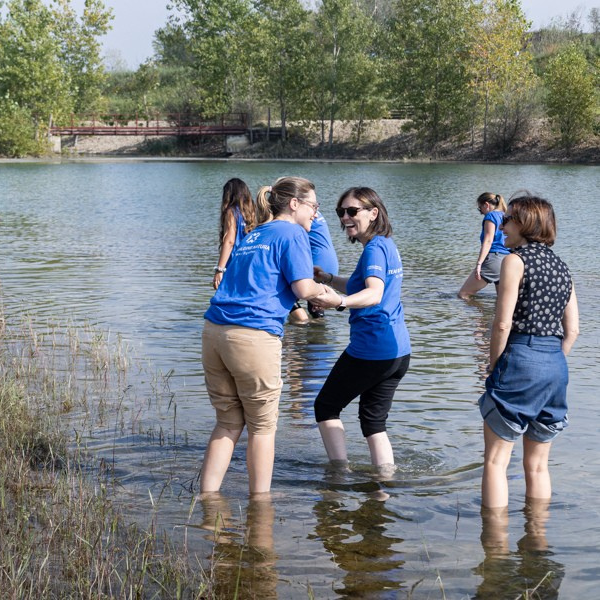
This is also why our outdoor team building experiences exist. They are designed to offer companies an effective tool through which team members can truly experience the importance of this powerful innate ability.
Working on empathy requires great care and attention to detail. It is essential to create the right conditions and build a safe space for exploration, where participants can experience freely and openly.
In this sense, Nature becomes the ideal partner. In contact with a natural environment, far from everyday dynamics, we can guide participants to cultivate that state of conscious presence which is essential for living an authentic and unfiltered experience.
A condition that allows us to shift our attention away from the constant flow of thoughts, bypassing mental models, judgments and beliefs. A state in which it becomes truly possible to experience Empathy in its most authentic form, free from the layers that often shape and condition our experiences.
Using Empathy Consciously
Every activity we design in our outdoor team building experiences related to Empathy aims to encourage its conscious use.
Our goal is to guide participants to directly experience their innate ability to connect with others — and with every living being — realizing how natural this process is and how deeply it belongs to their existence.
Each activity in Nature is also designed to be directly relatable to real workplace situations, offering insights and awareness that can be transferred into everyday professional life.
We invite participants to experience each activity from a dual perspective: as protagonists and observers. This means fully immersing themselves in the experience while at the same time paying attention to what is happening within them.
It is not an introspective journey, but rather an exploration. Through this process, participants begin to become familiar with the internal mechanisms that regulate empathy.
Just as we once learned to use language — moving from simple sounds to the construction of words and sentences — empathy too can be developed and consciously used through practice.
The facilitation sessions guided by our trainers that follow each activity serve precisely this purpose: to bring clarity to the mechanisms that emerged during the experience and transform them into awareness that can be applied in everyday professional life.
The goal is to provide participants with the tools to make Empathy a concrete resource they can rely on in every context, both professional and personal.


A Bridge Toward an Environment of Trust and Psychological Safety
So far, we have explored Listening, Emotional Intelligence and Empathy, describing them as three innate abilities that characterize us as human beings.
These are essential resources for our individual and collective evolution, and they are equally essential within organizational contexts.
But there is another fundamental aspect that matters to us. The first three principles of Team Building Natura®, together, represent in many ways our human nature — the great common denominator that unites us.
They represent the starting point for cultivating authentic relationships and building trust and psychological safety within a team.
This is why we believe that our five principles are independent, yet at the same time sequential: they follow a natural progression that makes each one the foundation for the next.
Only after consciously developing Listening, Emotional Intelligence and Empathy can we finally begin to talk about Trust.
In the next article, we will share our perspective on Trust, introducing the concept of Trust as a mindset. We will explore how trust is never the result of chance, but rather an intentional choice — and how it can create the conditions for new ideas and creativity to emerge.

Experiencing the Power of Connection Through Outdoor Team Building
As we have seen, empathy is an innate ability — a resource that can be trained and developed. But to do so, it must be experienced firsthand, lived in real contexts and understood through direct experience.
In our outdoor team building formats, participants have the opportunity to explore the channel of empathy in a direct and unfiltered way. Immersed in Nature and far from their usual dynamics, they can experience the power of connection and rediscover empathy as a concrete resource for themselves and for the team.
Practical Tools
Each experience is designed to offer practical tools that can be transferred into everyday professional life, making empathy a key element for more effective communication, more conscious leadership and a more cohesive and collaborative work environment.
Would you like to discover how to develop empathy within your team? Or learn how we can help you achieve any other goal?
Contact us and let’s design together the path that best fits your needs.
In the meantime, below are the links to the in-depth articles on the other Team Building Natura® principles:
#Listening: The First Step Toward Any Goal
#Emotional Intelligence: Transforming Emotions into Awareness