Sommario
- 1 The Fourth Stage in our Journey exploring the Team Building Natura® Principles
- 2 A Fundamental Role
- 3 Psychological Safety
- 4 Trust Cannot be Imposed
- 5 Trust as a Mindset
- 6 Case Study: The Delegation That Wasn’t
- 7 The Decisive Role of Trust in Organizations
- 8 Building a culture of Trust with Team Building Natura®
- 9 The Ideal Environment for Creativity
- 10 Discover the Power of Trust with our Outdoor Team Building Experiences
The Fourth Stage in our Journey exploring the Team Building Natura® Principles
The first three stages of our journey exploring the five Team Building Natura® principles have highlighted three innate abilities that define us as human beings: Listening, Emotional Intelligence and Empathy. We have seen how these abilities are deeply interconnected and, when used consciously, can represent an essential resource in every area of our lives, including the professional sphere.
These are qualities that are indispensable for our personal growth and fundamental for building authentic relationships, strong bonds and spaces for open and sincere dialogue, where everyone feels free to express themselves and contribute value to the team. Three innate abilities that naturally lead us to the fourth principle of Team Building Natura®: Trust.
A Fundamental Role
Trust is the element that can truly make the difference within a team. Its role is fundamental from multiple perspectives.
Trust in Ourselves
On an individual level, developing trust in ourselves means believing in our abilities and innate capabilities. It means learning to trust our inner voice, welcoming and understanding it. It means gaining greater confidence in our intuitions, moving beyond the fear of judgment, freeing ourselves from external conditioning and nurturing our self-esteem in a healthy way.
All these conditions inevitably help us improve the performance and results we are able to achieve.
Trust in Relationships
As we know well, trust also reflects itself in relationships. When a relationship is based on mutual trust, everything becomes much easier. Barriers begin to fall. We no longer feel the need to constantly protect ourselves.
We allow ourselves to open up. We feel we can confide in others without fear of being judged. We feel welcomed. We feel comfortable.


Psychological Safety
When these two perspectives coexist within a team—both at the individual level and within relationships among team members—the synergies that can emerge are extremely powerful.
A sense of psychological safety begins to spread throughout the group. Together with other factors—reliability, structure and clarity, meaning and impact—it allows the foundations for building a successful team to be established.
A team where everyone is ready to play an active role. People are willing to take risks and be vulnerable in front of others because they know that the ideas, initiatives and perspectives they choose to share will not lead to negative consequences.
A Safe Space
What emerges is an ideal context for developing modern and innovative leadership models, such as distributed leadership. An environment that encourages the adoption of practical tools such as delegation.
It stimulates participation and involvement from everyone, encouraging team members to take on increasing levels of responsibility without fear of making mistakes.
A safe space where a healthy culture of learning from mistakes can develop, supporting the growth of young talent. A scenario that encourages experimentation in the search for new ideas and solutions, and that promotes a mindset oriented toward continuous improvement through individual and collective learning paths.
An environment of trust and psychological safety characterized by authentic and emotionally open conversations. A place where real connections develop between people and everyone feels free to express themselves. An environment where each person represents added value thanks to their uniqueness.

Trust Cannot be Imposed
From this perspective, trust contributes significantly—if not essentially—to building a cohesive team, ready to welcome and face any new challenge with initiative, creativity, collaboration and unity of purpose. In other words, it helps create a successful team.
However, trust cannot be imposed. Nor can it be learned like any other skill. Trust in organizations is a form of culture that must be cultivated day after day.
It is an attitude that people consciously choose to adopt when certain conditions arise—and continue over time.
Human Nature
We believe that our human nature, particularly through the first three Team Building Natura® principles, plays a fundamental role when it comes to trust.
Through innate abilities such as Listening, Emotional Intelligence and Empathy, we can strengthen our self-esteem and gradually build greater trust in ourselves, in our intuitions and in our capabilities. These abilities help us develop a deep awareness of our inner experience, allowing us to open up to others without fear.
Our human nature also represents the fertile ground on which we can meet, recognize one another, break down barriers and build bridges. It allows us to cultivate authentic relationships that encourage sincere and constructive dialogue.
It enables us to create strong and lasting connections and to give ourselves—and others—the opportunity to become the best version of who we are.

Trust as a Mindset
Within the Team Building Natura® project we have explored the concept of trust in depth, because we consider it a fundamental element not only in organizations but also in our lives outside of work.
Step by step, this exploration led us to develop the idea of Trust as a mindset.
What does this Mean?
Cultivating a mindset oriented toward trust means adopting an open and curious attitude, willing to evaluate people, events and situations for what they truly are, without prejudice or labels.
This does not mean ignoring what life has taught us. Rather, it means learning not to be automatically influenced by mental patterns shaped by past experiences. Instead, it invites us to take a step back and calmly observe what is really happening before making rushed decisions.
From this perspective, trust does not depend exclusively on the responses we receive from others. It becomes first and foremost a conscious choice, in some ways independent of circumstances.
It is an act of individual responsibility that allows us to reclaim our personal power instead of delegating it to external events, people or situations over which we have no control.
A Mindset That Generates Great Benefits
This mindset generates significant benefits, starting at the individual level. It makes us more open to exploring new experiences and facing challenges with greater calm and openness.
It helps us preserve our personal power, freeing us from external conditioning that can limit our personal and professional growth.
But the impact of a trust-oriented mindset is also deeply relational. Because it is the result of a conscious choice, we begin to perceive others not as potential risks but as potential opportunities.
Others become a valuable resource for our growth and development, as well as for achieving individual and collective goals.
A Multiplier Effect
Moreover, within relationships this conscious choice to adopt a trust-oriented mindset is clearly perceived by others, creating a multiplier effect. People become more inclined to trust us, and we in turn become more inclined to trust them, in a continuous exchange. In this way, a virtuous cycle begins to take shape—one that sustains and reinforces itself over time.
A positive dynamic that plays a decisive role in building an environment of trust and psychological safety, ideal for creating successful teams. For this very reason, we believe that cultivating Trust as a mindset is an effective strategy—one that can evolve into a culture to be fostered within organizations, capable of generating benefits for individuals, teams and the organization as a whole.
Case Study: The Delegation That Wasn’t
Sandro is the CEO of a small-to-medium logistics company. A seasoned entrepreneur who has always been used to working hard. A person respected and appreciated by everyone around him, also thanks to the results he has achieved over time.
In recent years his company has grown significantly, forcing him to rethink the internal organization of the business.
A challenge Sandro faced with his usual determination and energy, successfully completing an ambitious restructuring project in a relatively short time. Thanks to the new organizational structure, he can now rely on four very close collaborators to whom— in his own way—he tries to ensure nothing is lacking.
Old Habits Die Hard
Despite the new organizational structure and the redistribution of responsibilities, Sandro has not managed to let go of his tendency to centralize most decisions and responsibilities.
He continues to personally manage the most critical activities, maintaining a strong level of control over daily operations. Over time, this attitude has slowly but steadily eroded the relationship with his closest collaborators.
One of them is Giuliano, who has worked with Sandro for about ten years.
From Enthusiasm to Disappointment
One day Sandro is forced to delegate an important assignment to Giuliano. Busy with other priorities, he quickly entrusts him with the task, providing only a few general guidelines without offering a complete picture of the situation.
Although surprised, Giuliano enthusiastically seizes the opportunity. Determined and motivated, he throws himself into the challenge and begins working on the assignment with great commitment.
However, several critical issues soon emerge that put the project at serious risk. These problems are largely related to external factors, but also partly due to a briefing that was incomplete in several respects.
Actions Speak Louder Than Words
Sandro quickly realizes that something is not going as expected and decides to intervene personally.
He does not discuss the situation with Giuliano or attempt to guide him in solving the problem. He simply informs him that he will take care of it himself. In practice, Sandro removes Giuliano from the assignment he had given him just days earlier, without offering any explanation.
In his mind, Sandro is convinced he is doing the right thing. After all, it is his company. And he reinforces the belief that, in the end, it is always better to handle things personally.
What he fails to realize is that he is confronting his own limits as a manager and entrepreneur. He does not understand that his leadership style is no longer effective.
In fact, it has become outdated and completely misaligned with the new organizational model.
The Last Straw
In an already tense situation, this decision becomes the final straw for Giuliano.
On one hand, he experiences Sandro’s intervention as a personal and professional rejection. He feels deeply disappointed. His confidence in his own abilities drops dramatically.
On the other hand, he becomes resentful toward Sandro. He perceives his behavior as inconsistent and superficial.
Since it is not the first time he or his colleagues have experienced a similar situation, Giuliano begins to ask himself some difficult questions: “With what mindset should I take on new responsibilities in the future?
And why should I continue investing my energy in this company? What is the point?”
A Feeling That Spreads
In the days that follow, the other three collaborators closest to Sandro begin asking themselves the same questions.
They had witnessed the entire situation as external observers. They too feel discouraged and frustrated, worn down by Sandro’s repeated behavior.
Even though they believe there is no ill intention behind his actions, they are no longer willing to accept this leadership style.
Inevitably, their state of mind begins to spread throughout the company.
Sense of belonging, engagement and enthusiasm gradually give way to discouragement, lack of direction and declining motivation. People begin focusing only on themselves.
Conflicts start to emerge. Individuals stop thinking as a team and instead begin protecting themselves.
Soon operational problems appear as well. The situation worsens day by day, leading to a scenario that would soon force Sandro to face himself and make definitive decisions.


The Decisive Role of Trust in Organizations
The story we have just shared has been one of the most challenging experiences we have encountered in recent years. And when it comes to trust, it is certainly a case study that offers many important reflections.
A Culture Oriented toward Trust
The first aspect we would like to highlight is the importance of cultivating an environment of trust and psychological safety every day and at every level within the organization. With the awareness that every choice, behavior and decision contributes—either positively or negatively—to the development of a culture oriented toward trust.
A culture that is built day by day, starting from recognizing one another first and foremost as human beings. Each person brings with them a unique set of experiences, emotions and feelings that cannot simply be ignored, because they are an integral part of who we are. A culture that grows through the development of authentic and sincere relationships, which tend to flourish almost naturally when people feel listened to and respected.
The Benefits of an Environment of Trust and Psychological Safety
In this way, relationships gradually become stronger. People connect with one another. The sense of belonging grows, and with it the desire to participate, contribute and take responsibility.
A space for dialogue emerges that is free from judgment, where everyone feels welcomed and able to express themselves openly. Free to step forward and take risks. Even free to make mistakes when necessary.
This type of environment encourages communication and collaboration and generates a sense of enthusiasm.
It is exactly the opposite of what we described in our case study, where the absence of trust and psychological safety produced uncertainty, discouragement and division—eventually leading to conflict, isolation and inefficiency.

A Trust-oriented Mindset Shapes Leadership Style
Another important aspect that clearly emerges from the case study we shared is leadership
It is evident that a leader always influences the team through their own attitude. It is therefore natural that, by adopting a trust-oriented mindset, a leader contributes to creating the psychological safety that is so important within organizations.
A leader encourages team members to act with courage. They nurture self-confidence and motivate people to trust their abilities and intuitions more deeply.
Managing Delegation from a Perspective of Trust
From this perspective, delegation also becomes an incredibly powerful tool—essential for recognizing and enhancing the value of team members.
Trust is no longer perceived as a temporary concession, granted while waiting for a final judgment. Instead, it becomes a true mindset, one that requires openness and willingness from everyone involved.
A leader who adopts a trust-oriented mindset understands that delegation is a process that must be carefully prepared and supported. It may require guidance when necessary.
Such a leader is aware that the right conditions must be created so that team members themselves are willing to step forward and take on new responsibilities.
A Culture that Embraces Learning from Mistakes
For this to happen, people must feel free to gain experience. In some cases, they must even feel free to make mistakes.
And this too is part of a leader’s responsibility: allowing collaborators to make mistakes, while remaining available to listen and offer valuable feedback when needed.
In other words, supporting them in their individual development process for the benefit of the team and the organization as a whole.
Each team member knows that the leader’s support will always be present. That their decisions will never be driven by prejudice and that labels do not define them.
There are only opportunities to be seized. And if today is not the right moment for someone, it simply means another opportunity will come tomorrow.
This mindset allows trust and psychological safety to spread throughout the team, shaping a cohesive and successful group ready to face every new challenge with enthusiasm.


Building a culture of Trust with Team Building Natura®
At this point, it becomes much easier to understand why Listening, Emotional Intelligence and Empathy represent essential abilities for us.
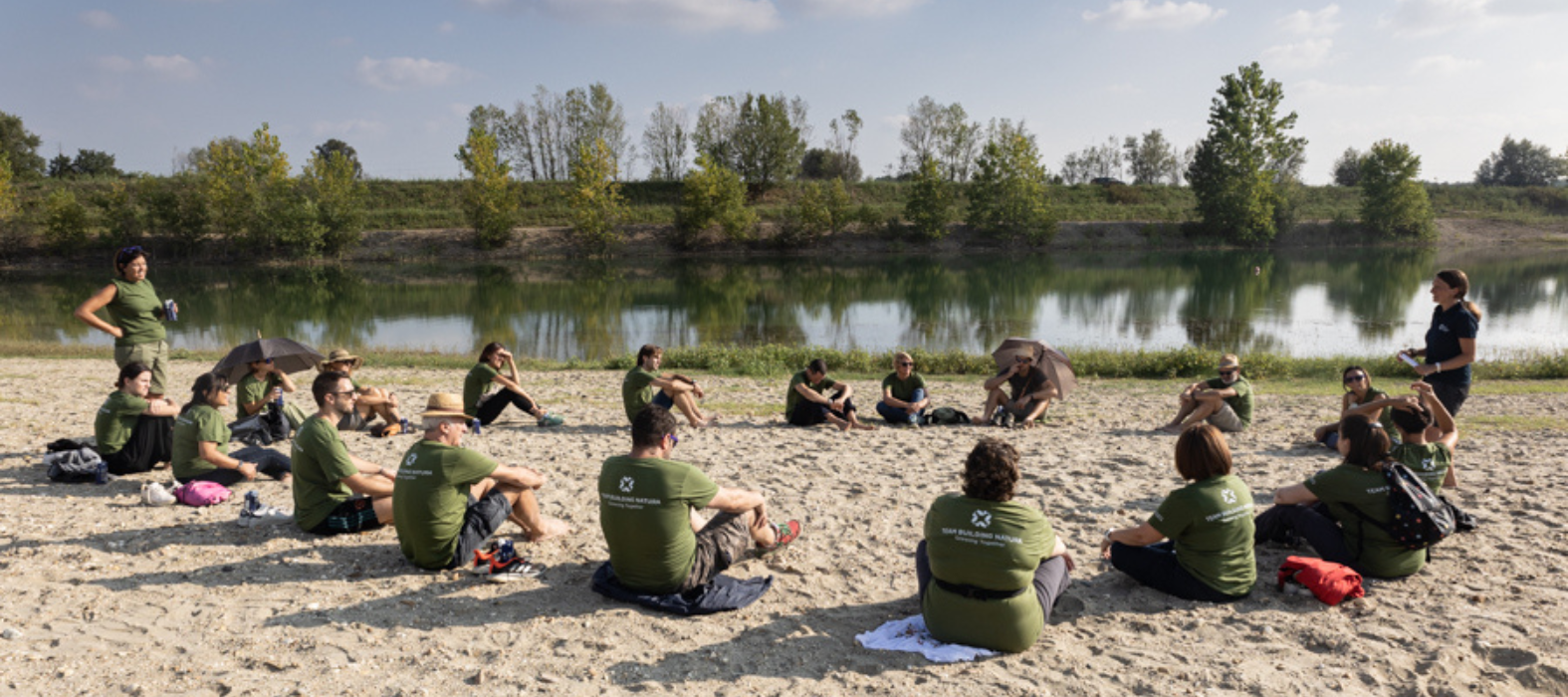
These innate capabilities allow us, during our outdoor corporate team building experiences, to create the authentic and sincere space for dialogue that is fundamental to our approach.
A space that is essential because, through Team Building Natura® formats, we want to offer participants the opportunity to experience the strength of relationships. To feel firsthand the power of spontaneous and genuine connections. To understand the real foundations upon which it is possible to build an environment of trust and psychological safety.
Without creating an authentic and sincere space for dialogue, none of this would be possible.
Where to Begin?
The first step for us is inviting the most human part of each participant to take center stage. We know that our humanity is the only true common ground on which we can meet.
It is the shared space that preserves our uniqueness while dissolving cultural, generational and linguistic differences.
For this reason, it is essential that team members recognize themselves—and others—first and foremost as human beings.
They must be able to move beyond barriers, prejudices and limiting beliefs that often accompany them in their daily professional lives, in order to fully experience the moment.
The Magic of our Team Building Experiences in Nature
Immersed in Nature, we guide participants to cultivate trust as a mindset, starting from themselves and their inner experience.
It is essential that each person becomes aware of what moves within them and develops trust in their own inner voice. It is equally important that they feel free to share it without fear of judgment.
When this happens, we begin to see each other for who we truly are.
We develop awareness of our emotions, ideas, intuitions and perspectives. As a result, we naturally become more respectful of those of others. We begin to relate to one another in an authentic and sincere way. We listen. And we lay the foundations for creating that safe space where people can truly meet.
This is the magic that unfolds during our outdoor team building experiences. And every time it happens, it is a wonderful process to witness.
A process that naturally emerges when we remember that, at our core, we are human beings.
The Ideal Environment for Creativity
As we have seen, Trust represents an essential component within a team. It fosters authentic relationships and contributes to building an environment of psychological safety.
Through a mindset oriented toward Trust, we can expand our map of possibilities and keep opportunities alive that might otherwise be lost. We can strengthen our self-confidence, learn to Trust our abilities and intuitions, and support both our own growth and that of others.
But what emerges is also an ideal environment for creativity.
A space where we can activate lateral thinking, express our uniqueness and allow ourselves to explore new ideas.
An environment where we are not afraid of being judged. Where we do not hesitate to share alternative thoughts or strategies. We feel encouraged to explore new paths and discover innovative, out-of-the-box solutions.
This is why Trust naturally leads us to the fifth principle of Team Building Natura®, which we will explore in the next and final article of this series: Creativity.
Discover the Power of Trust with our Outdoor Team Building Experiences
What we have shared here represents our vision of Trust and of a mindset capable of transforming the quality of relationships.
We are fully aware that cultivating a trust-oriented mindset can be challenging. At the same time, we strongly believe it is an opportunity worth embracing.
Only in this way can we reach increasingly ambitious results and achievements.
This is precisely why we created the Team Building Natura® formats.
Immersed in nature, through individual and group activities combined with facilitation sessions led by our experienced trainers, participants discover how cultivating a trust-oriented mindset can open new possibilities, strengthen cohesion, support change and create a more authentic and creative working environment.
Contact Us for an Introductory Call
If you would like to begin cultivating trust within your team in a concrete way, contact us for an introductory call.
We will be happy to answer your questions and design a tailored path that meets the specific needs of your organization.
In the meantime, below are the links to the in-depth articles on the other Team Building Natura® principles:
#Listening: The First Step Toward Any Goal
#Emotional Intelligence: Transforming Emotions into Awareness
#Empathy: The Innate Ability That Connects Us as Human Beings